


There is a pink stripe on the horizon...
and it's not the sunset!
ABSTRACT
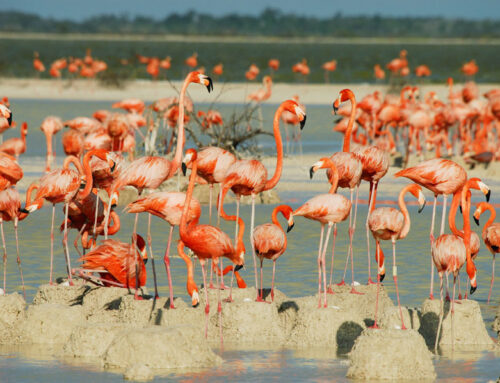
One of the most charismatic and distinctive bird species of the Caribbean is undoubtedly the pink flamingo (Phoenicopterus ruber). With an unmistakable silhouette, this slender species, with its gregarious behavior, is one of the symbols of coastal wetland conservation. The scientific name of this species comes from the Greek roots "phoinix" (crimson), "pterus" (wings) and "ruber" (red).
Flamingos are large waders, between 80 cm and 1.40 m long, with long necks (males 2.8 kg, females 2.2 kg). The beak is very characteristic and perfectly adapted for digging in the mud, with a pronounced downward curvature and internal lamellae (lamellae) to filter the food substances when filtering the silt. Flamingos feed by filtering crustaceans and algae. The filtration of this food is
It is supported by the structure of the beak and the large, rough tongue. It can also feed by picking up larger prey with its beak (but this is rare). The legs have four toes, the three front toes are joined by a membrane and the rear toe has four fingers.
very small.
ABSTRACT
One of the most charismatic and distinctive bird species in the Caribbean is undoubtedly the Pink Flamingo (Phoenicopterus ruber). With an unmistakable silhouette, this slender species, with gregarious behavior, is one of the symbols of the conservation of coastal wetlands. The scientific name of this species comes from the Greek roots "phoinix" (crimson), "pterus" (wings) and "ruber" (red).
Flamingos are large wading birds, between 80 cm and 1.40 m long, with long necks (2.8 kg males, 2.2 kg females). The beak is very characteristic, and perfectly adapted for digging in mud, with a pronounced downward curvature and equipped with internal lamellae (lamellae) to retain food substances when filtering the silt. Flamingos feed, through filtration, on crustaceans and algae. The filtration of this food is
It supports the structure of the beak and the rough and large tongue. It can also feed by picking up larger prey with its beak (but this is rare). The legs have four toes, the front three joined by a membrane and the back
very small rior.
You can read the complete article by clicking on the button
 English
  Español