

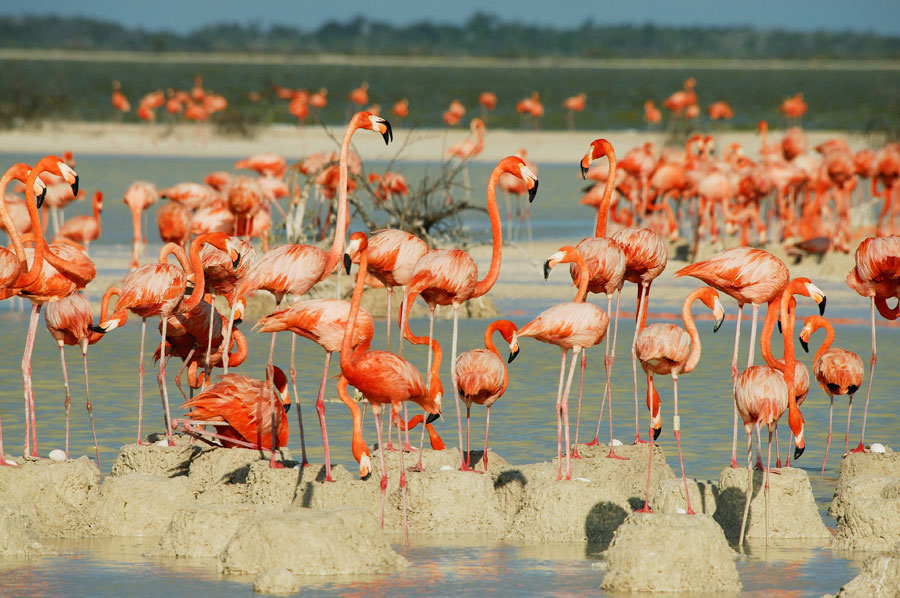
BREEDING OF THE CARIBBEAN FLAMINGO IN VENEZUELA
In Venezuela, the coastline in the Caribbean Sea, from Castillete in Zulia to the Paria Peninsula, Sucre, is 2,813 km long, where 53 wetlands of different sizes and ecological complexity have been identified, representing an important site for some 160 species of resident and migratory waterfowl.
Before the eighties of the last century, the flamingos observed (no more than 5,000 individuals) on the coast of Venezuela were generally referred to as "Flamingos of Bonaire, an island located 90 km off the eastern coast of Falcon State (Rooth 1986). De Boher (1979), pointed out that during the breeding season in Bonaire, flamingos occasionally fly to the coast of Falcón in Venezuela to look for food. He also commented on the strategic importance of the Chichiriviche lagoons (RFS Cuare) as feeding sites for the Bonairean population and the need to protect these habitats. Between 1982 and 1983, the first aerial surveys (Canadian Wildlife Service and Ministry of Environment) of flamingos were conducted on the coast of Venezuela (Morrison et al 1985).
 English
  Español